
UAE e-invoicing explained for small businesses
You keep hearing that e-invoicing is coming — from an accountant, a supplier, a post. Nobody says what it changes for a business your size.
What an e-invoice is
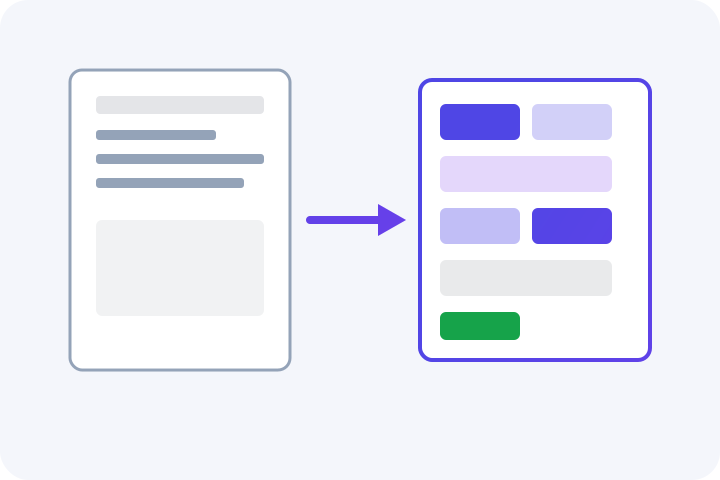
An e-invoice is structured invoice data. It is issued and exchanged electronically between a supplier and a buyer, and it is reported electronically to the Federal Tax Authority. The Ministry of Finance portal is explicit: a PDF, a Word file, an image, a scan or an email is not an e-invoice. Those formats can travel, but they are not the data the network expects.
Think of a form with named slots — seller, buyer, lines, totals — rather than a picture of a paper. Software can read those slots without retyping. That is the whole point. Your customer can still receive a human-readable PDF if you send one; the e-invoice is the structured record underneath.
Why the UAE is doing it
The legal basis is Ministerial Decision No. 243 of 2025 and Ministerial Decision No. 244 of 2025, issued 29 September 2025, with later instruments on the same portal. The model is decentralised continuous transaction control on the Peppol network: you send through your Accredited Service Provider, the buyer receives through theirs, and both providers report to the Federal Tax Authority. The Ministry of Finance portal states that it is the only official source for the programme.
The stated aims on the portal include less manual tax reporting, faster invoice cycles, and less VAT leakage. Administrative penalties for violating the e-invoicing legislation exist under Cabinet Decision No. 106 of 2025. This article does not list amounts; amounts change. If you need the annex, open the decision on the portal.
Who it applies to
The rules cover B2B, B2G, G2B and G2G supplies. B2C is excluded until further notice. The decisions also exclude sovereign government transactions, certain airline services, and exempt financial services. This article addresses the supplier-side obligations of small businesses — the people who issue invoices to other businesses or to government — and says so.
If you only sell to consumers, you are outside the e-invoicing mandate for now. If you sell to businesses or government, you are in scope even when your revenue is modest. Revenue changes when you must appoint a provider and go live; it does not change whether the rules apply. The next article walks that checklist.
When
A voluntary pilot opens on 1 July 2026 for any revenue. Businesses below the large-revenue phase go live on 1 July 2027, after appointing an Accredited Service Provider earlier that year. Larger businesses and government entities have their own dates on the same timeline. Read the full table in UAE e-invoicing deadlines: 2026 and 2027 rather than treating one circular as the last word.
What changes day to day
Every invoice needs complete details: your legal name and tax number, the buyer's name and tax number or TIN, full addresses, line descriptions, quantities, prices, VAT category and rate per line, and totals. You will appoint an Accredited Service Provider when your date arrives. You issue the e-invoice within 14 days of the taxable event. You keep electronic records retrievable and available to the Federal Tax Authority — the infrastructure may sit inside or outside the UAE. Self-billing is permitted for registered taxpayers.
None of that is a new tax. It is a new way of writing down the same sale. The work is in having the slots filled before you send, not in learning a new tax rate.
What does not change
VAT rates do not change because e-invoicing arrives. Your customers are still your customers. Your prices are still your prices. A five-percent line stays five percent. A zero-rated export does not become standard-rated because the file is XML. What changes is that an incomplete address or a missing buyer tax number will fail a machine check instead of sitting unnoticed in a PDF.
You do not become an Accredited Service Provider by using a bookkeeping app. Transmission to the Federal Tax Authority is the provider's job. Getting the record into the right shape is yours.
Questions owners ask
Is a PDF invoice an e-invoice?
No. The Ministry of Finance portal says unstructured formats — PDF, Word, images, scans and emails — are not e-invoices. An e-invoice is structured data that can be exchanged and reported electronically.
Do I need new software?
You need a way to keep records in the required shape and to hand them to an Accredited Service Provider when your date arrives. That can be software you already use, a new tool, or a mix, as long as the data is complete. The rules do not name a brand.
I am not VAT-registered — does it apply?
Yes, if you make B2B or B2G supplies. A seller who is not VAT-registered issues a commercial invoice rather than a tax invoice. Registration changes the document type, not whether e-invoicing applies.
What about invoices to consumers?
B2C supplies are excluded from e-invoicing until further notice. If all of your customers are consumers, the mandate does not reach those invoices yet. If you sell to both consumers and businesses, the business invoices are in scope.
How Fatura Sahla helps
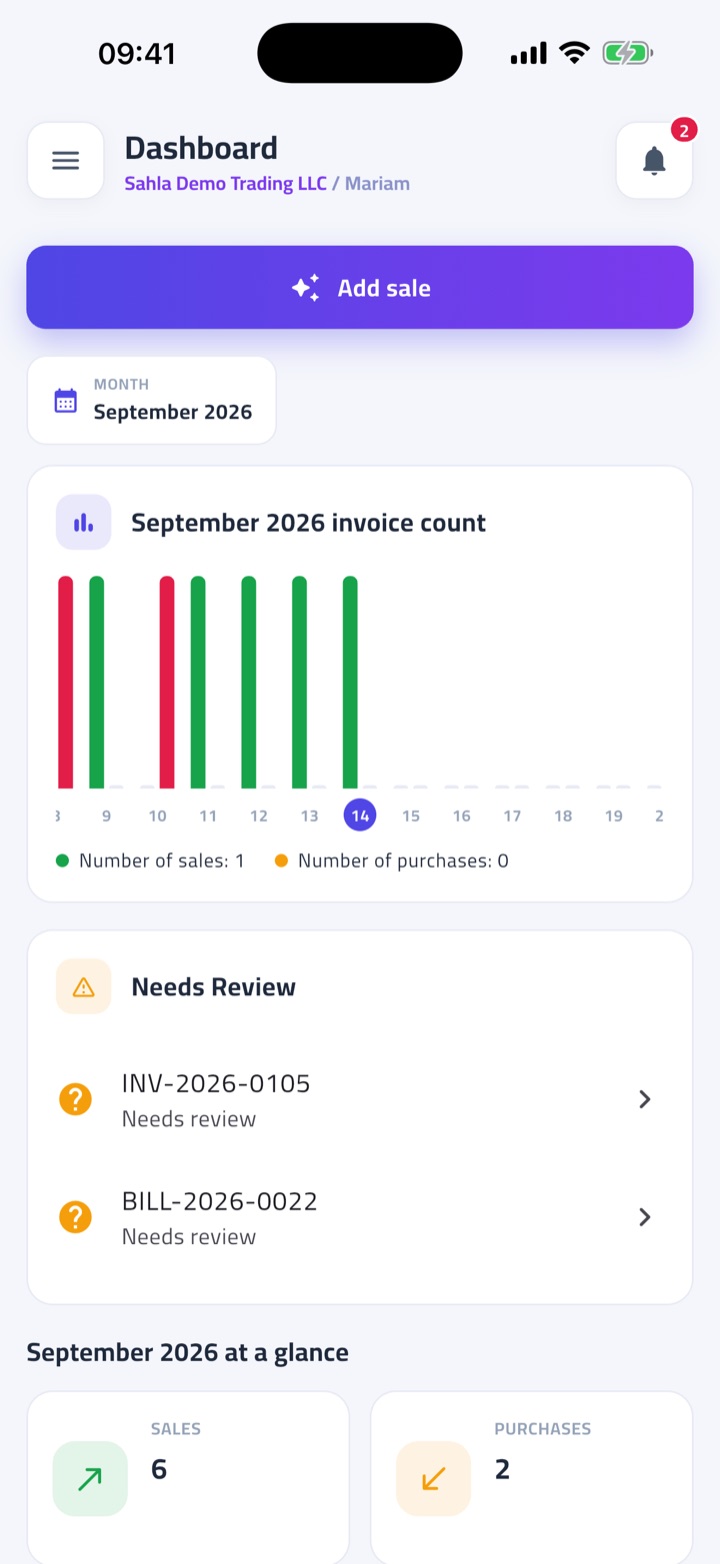
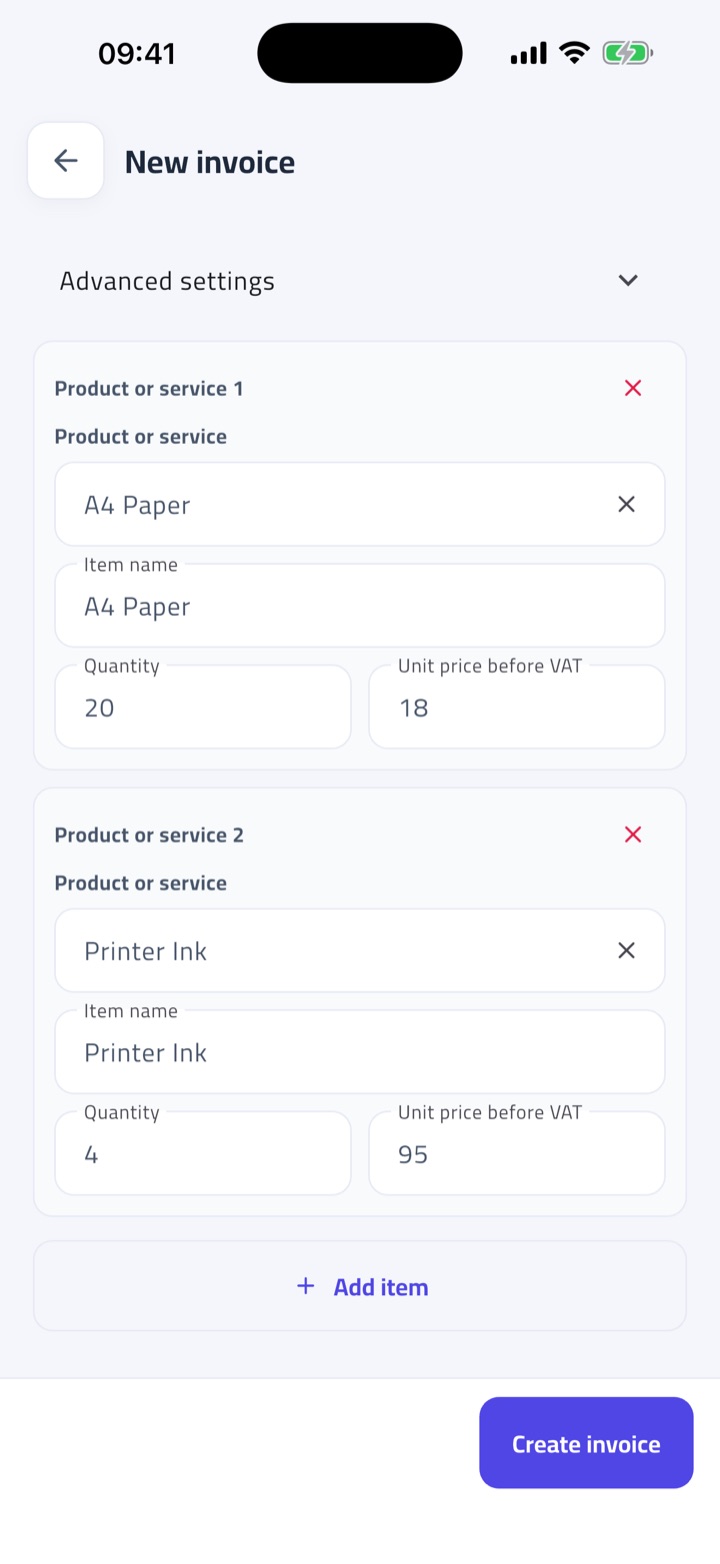
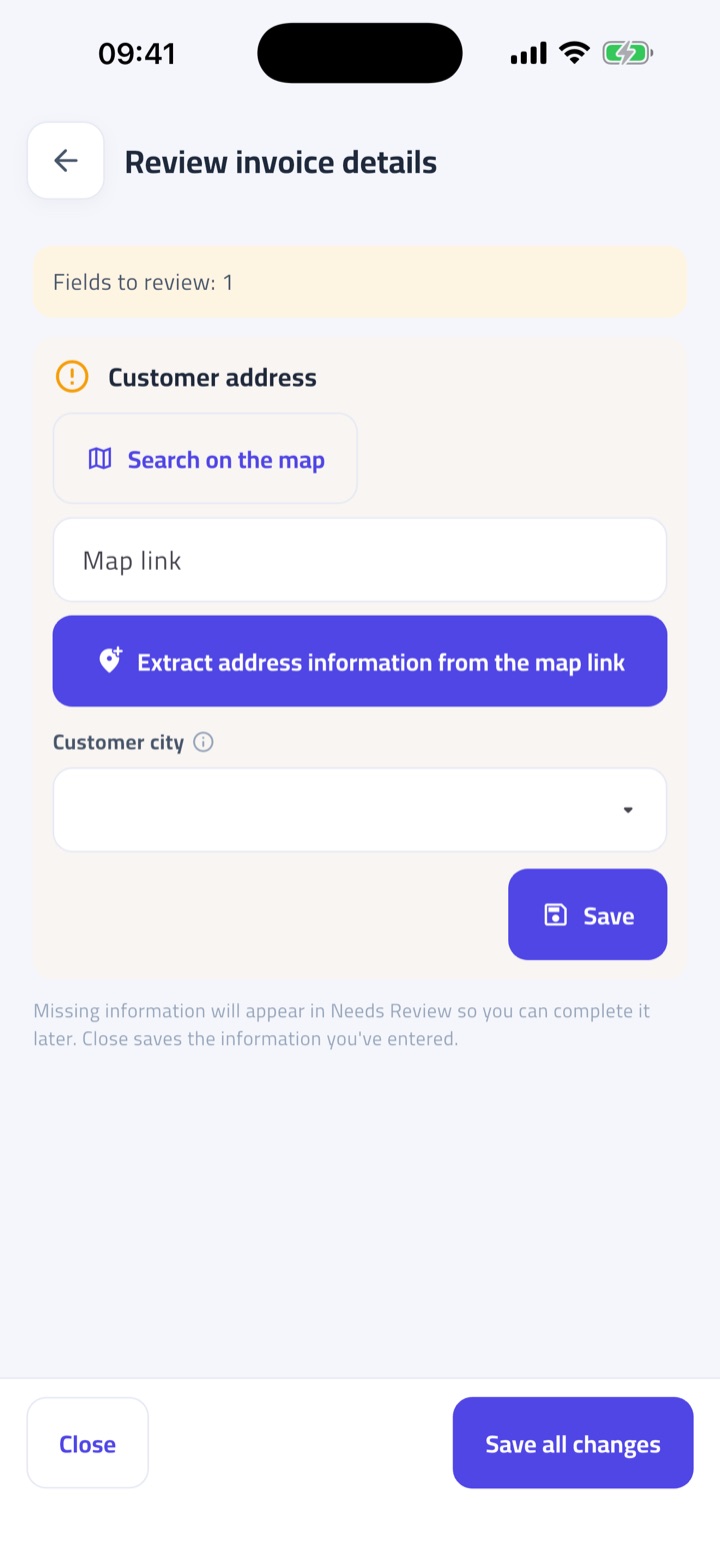
Records are kept in the PINT-AE shape from the first invoice. Each invoice is checked in plain words. You can export XML when the rules ask for it.
We meet you where you are, and get you e-invoice-ready with near-zero overhead.
Your sales live in notebooks, spreadsheets and sales people in the field
Photograph the paper, import the sheet, or type it in. Every path ends in one complete record, checked in plain words.
A computer, a smartphone, a tablet, or a simple phone with WhatsApp
Works in the browser and on Android and iPhone. Send an invoice photo to WhatsApp and get the finished PDF back in the chat.
A team that reads English, Arabic, Urdu, Hindi, or a mix of them
The app, the WhatsApp replies and every check speak all four. Invoices print in English or Arabic, whatever the team uses.
Fatura Sahla helps you get ready. It is not an Accredited Service Provider and does not send invoices to the Federal Tax Authority. This article is general information, not tax advice.
Last reviewed September 14, 2026
Sources
- Ministry of Finance — eInvoicing
- Ministerial Decision No. 243 of 2025 on the Electronic Invoicing System
- Ministerial Decision No. 244 of 2025 on the Implementation of the Electronic Invoicing System
- Cabinet Decision No. 106 of 2025 on the Violations and Administrative Penalties Resulting from Violation of the Legislation Regulating the Electronic Invoicing System
- UAE Electronic Invoicing Guidelines